
Specialist Food Suppliers, Chefs, and the Claims of the Best Foods
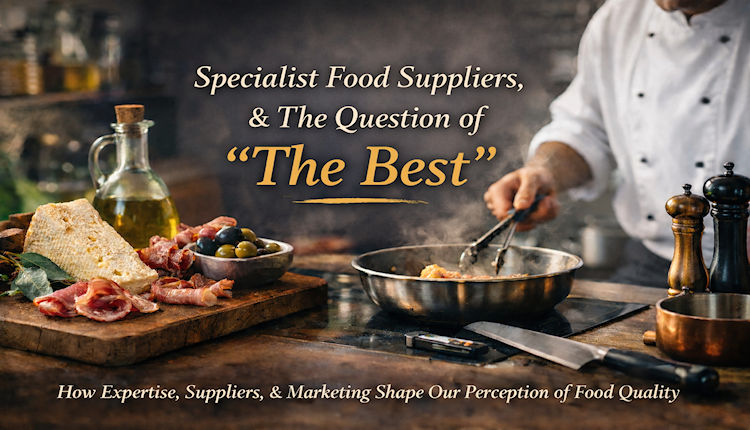
The So Called Specialist Food Suppliers, Chefs, and the Question of “The Best” …
In today’s food culture, specialist food suppliers, gourmet brands, and professional chefs play a powerful role in shaping what is presented as “the best” in ingredients, appliances, and cooking methods
From artisan producers to celebrity-led endorsements, these voices influence both professional kitchens and everyday consumers. However, the idea of “the best” is rarely absolute and deserves closer examination.
Specialist food suppliers typically focus on quality, provenance, and differentiation. They source products such as artisan cheeses, single-origin oils, rare spices, heritage meats, and small-batch produce that are not designed for mass retail. Their value lies in consistency, traceability, and flavour depth rather than volume.
For chefs and food professionals, these suppliers provide access to ingredients that help define a restaurant’s identity. For consumers, they often represent authenticity, craftsmanship, and a closer connection to how food is produced.
Chefs are frequently positioned as arbiters of quality. Their recommendations—whether for ingredients, cookware, or appliances—carry weight because they are grounded in daily professional use. A chef’s priorities usually include reliability, performance under pressure, and suitability for specific techniques.
However, chef endorsements are shaped by context. What works perfectly in a high-volume commercial kitchen may be unnecessary or impractical for a home cook. Likewise, personal style, cuisine type, and supplier relationships all influence what a chef considers “best.”
The same dynamic applies to kitchen appliances and tools. Many products are promoted as chef-approved or industry-standard, implying universal superiority. In reality, equipment choices depend on workflow, budget, space, and frequency of use.
A premium appliance may offer durability and precision, but it does not automatically produce better results without skill and appropriate application. Claims of excellence should therefore be understood as informed opinions rather than objective truths.
Across suppliers, chefs, and manufacturers, quality and consistency remain the common thread. High-quality ingredients reduce waste, improve reliability, and support better outcomes. Yet quality is experienced subjectively, shaped by taste, cultural expectations, and individual priorities.
Independent reviews, awards, and consumer testing can provide useful additional perspectives, helping to balance professional endorsements with broader evaluation.
Specialist food suppliers and chefs contribute valuable expertise to the food ecosystem, offering insight into ingredients, tools, and techniques that perform well in demanding environments.
However, claims of “the best” should be viewed as contextual rather than universal, as many simply mirror or copy — often referred to as jumping on the bandwagon — prevailing trends or replicate what others are already doing while presenting it as differentiation?
Ultimately, letting the consumer be the judge is a far more compelling marketing strategy than merely making lofty claims. If these chefs and gourmet businesses are truly confident in their offerings, then providing free samples that would reflect their gourmet skills and allowing the public to decide would speak far louder than any assertion.
So always take an informed approach – consider sources, purpose, and personal need – to maintain the most reliable way to judge what is claimed as being – quality!
Be sure to subscribe to our periodical newsletter so whenever we have any food-related news, you’ll be amongst the first to know!
[/bs-text][better-ads type=”campaign” banner=”none” campaign=”12868″ count=”1″ columns=”1″ orderby=”rand” order=”ASC” align=”center” show-caption=”1″ lazy-load=””]

